Digital Risk Report 2026
This report explores the evolving digital risk landscape and key considerations for organizations navigating emerging challenges.
Contributors:
Brandon LaLonde
CIPM
Research & Insights Analyst
IAPP
Joe Jones
Research and Insights Director
IAPP
The current digital governance and risk landscape is undergoing profound and challenging transformation, driven by the rapid proliferation of generative and agentic artificial intelligence, an increasingly fragmented global regulatory environment and escalating geopolitical tensions.
As organizations attempt to harness ever-advancing, data-driven technologies in pursuit of market advantage and innovation, they are simultaneously forced to navigate a complex maze of compliance mandates, cybersecurity threats and structural, organizational shortcomings. The convergence of digital governance domains has given rise to an increasingly aligning discipline of digital responsibility.
A key pillar for any digitally driven organization is risk management. In the modern organizational environment, the digital risk landscape has evolved to become one of the most critical factors, defining both success and survival. As organizations become increasingly interconnected, if not interdependent, through complicated technological ecosystems, the boundaries of traditional risk management blur.
The pursuit of competitive edge and comparative advantage has resulted in risk management functions being increasingly tasked as enabling risk taking, as well as being stewards of risk mitigation and management.
The pace of technological advancement often outpaces the development of comprehensive risk strategies, leaving many organizations operating in a climate of complexity. Yet, within this ambiguity lies an opportunity for digital risk management professionals to step forward as indispensable leaders. Now is the time to move beyond defensive postures and actively shape the overarching strategies that mitigate risk and empower organizations.
Since the beginning of the year, the IAPP has polled digital governance professionals through the 2026 IAPP Governance Survey, interviewed senior leaders across multiple industries and performed analysis of various organizations' Form 10-Ks and annual reports to inform this report and empower the field when it comes to digital risks.
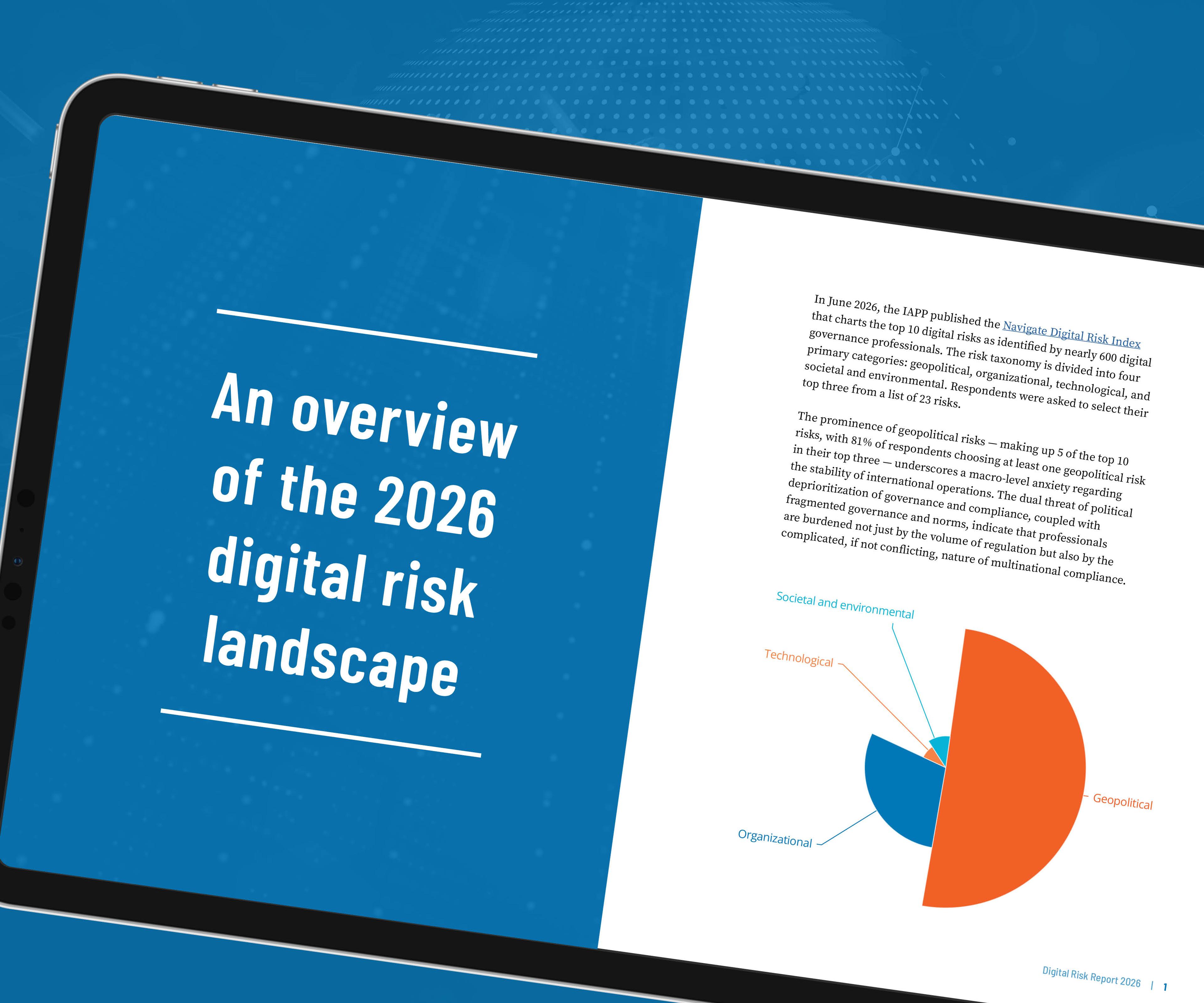
In June 2026, the IAPP published the Navigate Digital Risk Index that charts the top 10 digital risks as identified by nearly 600 digital governance professionals. The risk taxonomy is divided into four primary categories: geopolitical, organizational, technological, and societal and environmental. Respondents were asked to select their top three from a list of 23 risks.
The prominence of geopolitical risks — making up 5 of the top 10 risks, with 81% of respondents choosing at least one geopolitical risk in their top three — underscores a macro-level anxiety regarding the stability of international operations. The dual threat of political deprioritization of governance and compliance, coupled with fragmented governance and norms, indicate that professionals are burdened not just by the volume of regulation but also by the complicated, if not conflicting, nature of multinational compliance.
The digital regulatory environment in 2026 is defined by volatility, volume, fragmentation and geopolitical paradox. Many multinational organizations feel stuck in a jurisdictional quagmire, where compliance strategies in one market may directly violate or be at odds with the legal requirements of another. This is especially true for small organizations: While 22% of respondents to the Digital Risk Index identified this issue as one of their top three risks, this percentage rises to 35% for organizations that bring in less than USD10 million in revenue and 40% for those with under 50 employees.
This sentiment is further supported by the fact that nearly 40% of respondents identified "inconsistencies between national requirements that create conflicting obligations" as the primary policy and legal challenges in creating a more predictable and coherent privacy and data protection environment. These inconsistencies and fragmentations leave organizations navigating sovereign mandates, creating operational friction and potential legal exposure.
These risks have second order effects as well. For example, many organizations aim to leverage one overall compliance approach that attempts to follow the strictest regulations and laws for the markets in which they operate. However, these attempts at aligning compliance may be prohibitively costly and keep organizations from innovating and competing at pace with competitors in jurisdictions with more relaxed compliance programs. Indeed, several of the senior leaders interviewed identified this very issue.
It is not just external forces causing friction. Internal organizational risks are also top of mind for many professionals, making up 3 out of the top 10 risks. A total of 77% of respondents chose at least 1 organizational risk in their top three. With issues such as legacy processes and insufficient budget, it seems like many organizations are attempting to implement next-generation technologies atop brittle and outdated operational foundations. The failure to secure adequate budget prevents the modernization of data mapping and governance, vendor management and talent recruitment, exacerbating downstream vulnerabilities. This comes as organizations are also deprioritizing governance and compliance, likely due in part to not wanting to feel left behind.
It is unequivocal that digital risk can no longer be managed as a distinct, standalone function focused primarily on compliance. Organizations are in the process of redefining their risk management practices and overall governance structures to reflect this, elevating the importance of digital risk management to the highest levels of executive and board-level planning.
The future of digital responsibility, and those who manage the risk within it, lies in robust governance structures bolstered by cross-functional talent. Organizations who recognize this can transform digital risk functions into enablers of sustainable and competitive innovation.
Contributors:
Brandon LaLonde
CIPM
Research & Insights Analyst
IAPP
Joe Jones
Research and Insights Director
IAPP