Top 10 operational impacts of the EU AI Act
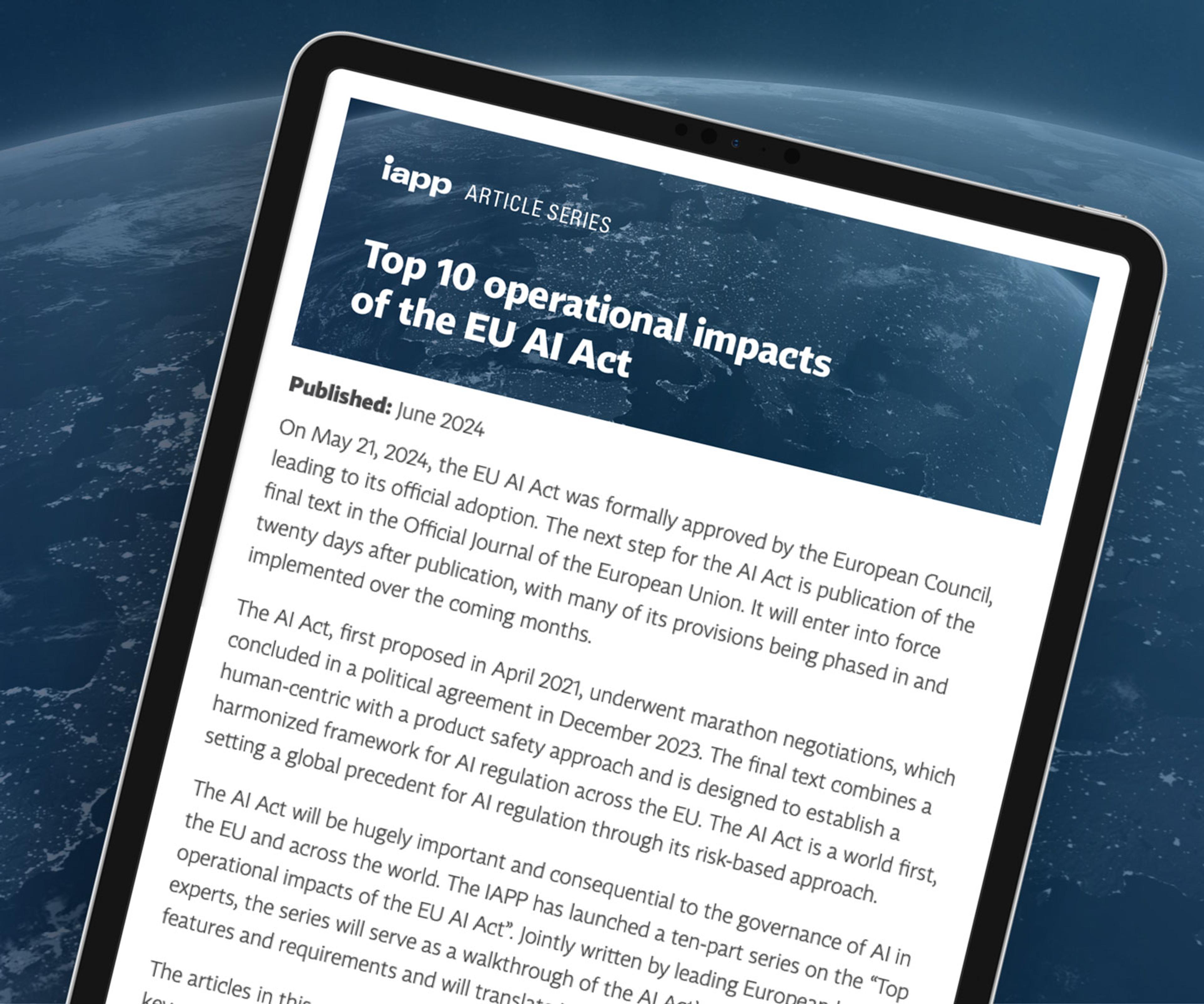
This article series serves as a walkthrough of the most important components of the EU AI Act.
Contributors:
Uzma Chaudhry
CIPP/E
Former AI Governance Center Fellow
ATI
Ashley Casovan
Managing Director, AI Governance Center
IAPP
Joe Jones
Research and Insights Director
IAPP
First proposed in April 2021, the AI Act underwent marathon negotiations, which concluded in a political agreement in December 2023. The final text combines a human-centric approach with a product-safety approach and is designed to establish a harmonized framework for AI regulation across the EU. The AI Act is a world first, setting a global precedent for AI regulation through its risk-based approach.
The act will be hugely important and consequential to the governance of AI in the EU and worldwide. The IAPP has published a ten-part series on the EU AI Act's top operational impacts. Jointly written by leading European legal experts, the series provides a walk through of the AI Act's most important features and requirements, translating its provisions into actionable terms.
The published text of the EU AI Act is only the beginning. Now entered into force, the act will undergo a phased approach to implementation, including further rulemaking and enforcement. Moreover, it did not come into force in a vacuum. While the AI Act is a first for EU regulation specifically targeted at the risks associated with certain AI systems, the EU has a growing digital regulatory framework with many intersections to how AI systems are governed.
This article series serves as a walkthrough of the most important components of the EU AI Act.
Series Overview
Subject matter, definitions, key actors and scope
This article introduces the EU AI Act’s foundational concepts, outlining its subject matter, key definitions, regulated actors and overall scope while explaining why organizations must begin interpreting these concepts ahead of full implementation.
View article
Understanding and assessing risk
This article explains the AI Act’s risk‑based approach, detailing how risk categories are defined and how organizations should understand, classify and evaluate risks associated with different AI use cases.
View article
Obligations on providers of high-risk AI systems
This article examines the extensive obligations imposed on providers of high‑risk AI systems, including organizational, documentation, design and regulatory requirements set out in Chapter III of the AI Act.
View article
Obligations on nonproviders of high-risk AI systems
This article explains the obligations placed on deployers, importers, distributors and authorized representatives of high‑risk AI systems, emphasizing their shared responsibility to ensure transparent, safe and compliant system use under Chapter II, Section 3 of the AI Act.
View article
Obligations for general-purpose AI models
This article analyzes the AI Act’s dedicated regulatory framework for general‑purpose AI models, explaining how legislators responded to the rise of generative AI by creating a new chapter with obligations for both standard and systemic‑risk models.
View article
Governance: EU and national stakeholders
This article outlines the complex governance structure established by the AI Act, describing the roles and competencies of EU-level and national bodies involved in implementation, coordination and enforcement.
View article
AI Assurance across the risk categories
This article explores assurance mechanisms used to evaluate and validate AI systems, explaining how oversight tools such as standards, conformity assessments and audits help measure the trustworthiness and safety of AI across risk levels.
View article
Post-market monitoring, information sharing and enforcement
This article details the AI Act’s requirements for post‑market monitoring, including ongoing system evaluation, reporting of serious incidents, and enforcement structures inspired by EU product‑safety frameworks.
View article
Regulatory implementation and application alongside EU digital strategy
This article situates the AI Act within the broader EU digital regulatory landscape, discussing how its phased implementation aligns with the Digital Single Market strategy and intersects with other digital laws.
View article
Leveraging GDPR compliance
This article highlights how existing GDPR compliance efforts can support organizations in meeting AI Act obligations, emphasizing overlapping principles, shared rights protections and the AI Act’s numerous references to GDPR requirements.
View article
Contributors:
Uzma Chaudhry
CIPP/E
Former AI Governance Center Fellow
ATI
Ashley Casovan
Managing Director, AI Governance Center
IAPP
Joe Jones
Research and Insights Director
IAPP